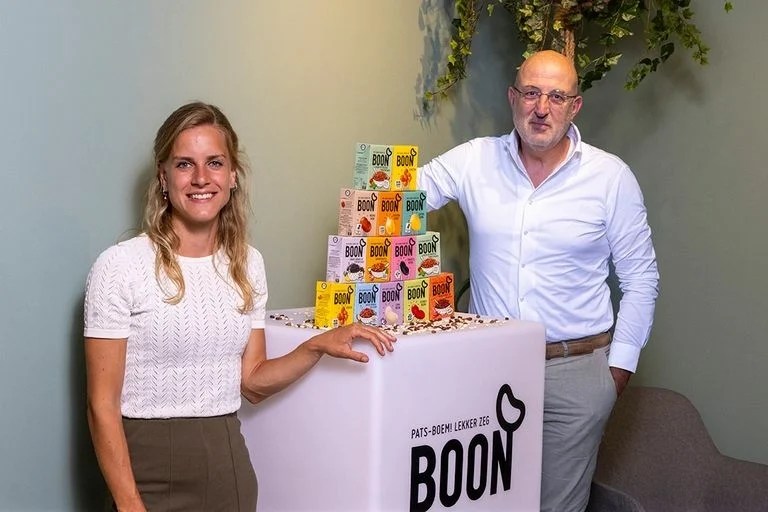
There is something almost timeless about beans. They arrive quietly, often in bulk, dried and patient, stacked in warehouses in volumes that seem to belong to another era. In facilities like those operated by JAMEL Food Group, beans quite literally “have no hurry.” They can wait. And for decades, they did—waiting not just for processing, but for a place in the modern consumer’s routine.
Yet something is shifting. Across Europe, and particularly in the Netherlands, legumes are slowly re-entering the conversation. Not as nostalgic leftovers from traditional cuisine, but as part of a broader movement toward healthier, more plant-forward eating. The challenge, however, has never been nutritional value. Beans have always been rich in protein, fiber, and micronutrients. The real challenge has been perception.
For many consumers, beans remained associated with the past—heavy meals, limited variety, and a lack of inspiration. It is precisely this perception that JAMEL and its brand BOON set out to change.
From Warehouse Staple to Shelf Attraction
Walk into a modern supermarket today and the difference becomes immediately visible. Where once beans were confined to the lower shelves—hidden among canned goods and overlooked staples—they are now increasingly stepping into the spotlight. Not by chance, but by design.
BOON’s strategy is deceptively simple: make beans visible, approachable, and relevant. This begins with flavor. Instead of presenting legumes as standalone ingredients, the brand integrates them into globally inspired recipes—black beans in teriyaki sauce, chickpeas in tajine-style dishes, lentils with Indian spice blends. These are not products that require culinary expertise; they are designed to fit seamlessly into busy daily routines.
But perhaps the most striking change is not what is inside the product, but how it is presented.
The Moment Packaging Changed the Game
When BOON introduced its legumes in Tetra Recart packaging, the effect was immediate. The category—long dominated by glass jars and metal cans—suddenly looked different. Brighter. Lighter. More contemporary.
It is easy to underestimate the impact of this shift. Packaging, after all, is often seen as a logistical or environmental decision. But in retail, it is also a language. And Tetra Recart speaks a very different language than traditional formats.
The cartons are lighter and more space-efficient, allowing retailers to place more units on the same shelf. They are easier to transport, reducing the environmental footprint across the supply chain. And perhaps most importantly, they offer a canvas for branding that feels modern and expressive. In a category that had long been visually static, this alone represents a significant breakthrough.
Behind this visual transformation lies a robust technological foundation. Tetra Recart combines carton-based packaging with thermal sterilization, enabling products to achieve full shelf stability without refrigeration. This is not a compromise on safety or shelf life—on the contrary, it delivers the same microbiological reliability as conventional retort systems, while protecting flavor and texture.
In other words, the innovation is not just aesthetic. It is deeply functional.
Local Production in a Global Market
Another layer of JAMEL’s strategy becomes visible not on the shelf, but behind the scenes. While many food companies rely on international production networks, JAMEL has chosen to keep a significant part of its processing close to home. The BOON Tetra Recart products are filled and sterilized in the Netherlands, a decision that reflects both practical and strategic considerations.
In an increasingly uncertain geopolitical environment, supply chains have become less predictable. Export restrictions, logistical disruptions, and fluctuating commodity markets all play a role. By maintaining local production capabilities, JAMEL gains a degree of control that is difficult to achieve in fully globalized systems.
At the same time, the company operates within the realities of agriculture. Not all legumes can be grown efficiently in Northern Europe. Chickpeas and lentils, for example, often require sourcing from regions with more suitable climates. The result is a hybrid model—local where possible, global where necessary.
This balance is becoming a defining feature of the modern food industry. It is no longer about choosing between local and global, but about integrating both in a way that enhances resilience.
A Market in Transition
The broader market context reinforces this shift. Consumption of legumes in the Netherlands has historically been low, far below dietary recommendations. Yet recent years have shown signs of recovery. Growth in sales—driven largely by convenience products—suggests that consumers are willing to re-engage with the category, provided it is presented in a way that fits their lifestyle.
Retailers are responding accordingly. Shelf space for legumes is expanding, and products are increasingly placed in more prominent locations, sometimes even alongside fresh produce. This repositioning is crucial. Food choices are often made within seconds, influenced by visibility as much as by intention.
At the same time, the competitive landscape remains challenging. Price sensitivity continues to shape purchasing decisions, and producers like JAMEL must navigate the tension between cost competitiveness and local sourcing. European agriculture faces higher costs for land, labor, and energy, making it difficult to compete with imports from lower-cost regions.
And yet, innovation offers a way forward. By adding value—through product design, convenience, and packaging—companies can move beyond pure price competition. BOON’s success illustrates this principle: it is not just selling beans, but a new way of consuming them.
Tradition Meets Technology
What makes the story of JAMEL and BOON particularly compelling is the way it bridges two worlds. On one hand, there is a deeply traditional product, rooted in agriculture and history. On the other, there is a modern system of processing, packaging, and marketing that transforms how that product is perceived.
Sterilization, in this context, is not merely a technical step. It becomes part of a broader narrative about reliability, shelf stability, and global food distribution. Combined with Tetra Recart packaging, it enables a format that is both efficient and adaptable to contemporary needs.
This combination—of process innovation and consumer insight—may well define the future of shelf-stable foods. As diets shift and supply chains evolve, the ability to deliver nutritious, convenient, and sustainable products will only become more important.
A Quiet Transformation
Perhaps the most remarkable aspect of this transformation is how quietly it is unfolding. There are no radical new ingredients, no disruptive technologies in the conventional sense. Instead, there is a series of thoughtful innovations—each incremental, but together significant.
Beans, after all, have not changed. They remain what they have always been: simple, durable, and nutritionally powerful. What has changed is everything around them—the packaging, the positioning, the context in which they are consumed.
And in that shift, companies like JAMEL Food Group and BOON are demonstrating something essential: that even the most familiar foods can be reimagined, not by abandoning their roots, but by giving them a new form.
In the end, the “dusty bean” has not disappeared. It has simply been given a new identity—one that fits the pace, preferences, and expectations of a modern food system.

 Fresh Food Novelties
Leave a comment