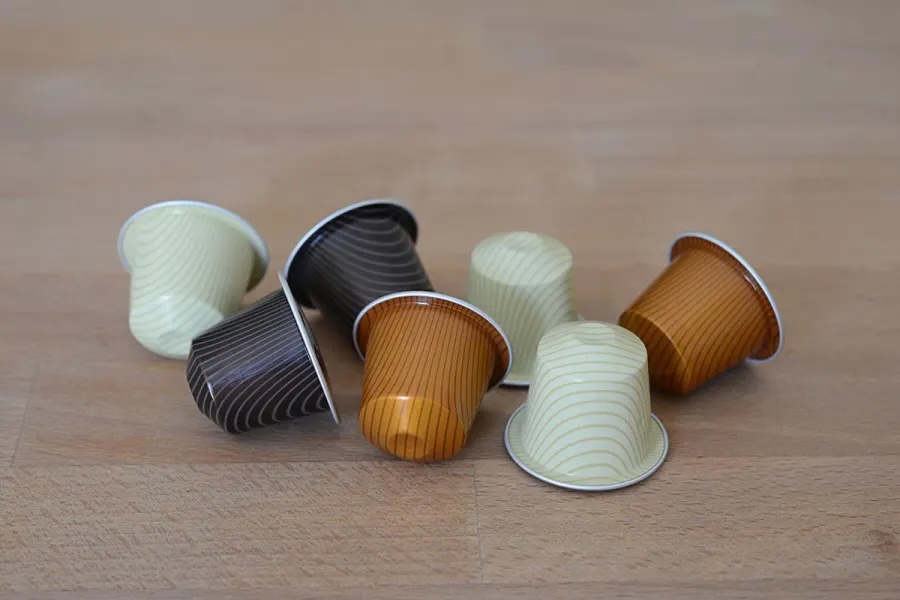
Nespresso didn’t just sell convenience; it industrialized repeatable espresso. What looks like a simple aluminum cup hides a string of small, defensible design choices—materials, fluid dynamics, thermal engineering, and grind science—that together produce a fast, consistent shot from a cheap countertop machine. After Nespresso’s capsule patents began to lapse in the 2010s, many assumed high-quality roasters would immediately outflank the system on taste. Yet “Nespresso-compatible” rarely felt truly compatible. The reason is technological: Nestlé optimized the entire chain—from how water meets coffee to how particles are milled—so that the system functions as one.
This article unpacks the key elements of that system and what they imply for refillables and third-party capsules.
Capsule engineering: more than a tiny can
At first glance, a Nespresso capsule and an independent aluminum pod look alike: same taper, same foil lid. Flip them over and a crucial difference appears. Under the rim of a genuine capsule sits a narrow silicone gasket that Nespresso still holds IP over. That gasket matters. In classic machines—think the ubiquitous Magimix Inissia—the capsule is pushed into a brewing chamber where three needles pierce its back to admit water. The front face of the capsule must seal perfectly against a toothed seating ring. Without a compliant gasket, the interface can weep. A small leak erodes pressure, shortens contact time, and delivers a weak, messy shot; it also makes consumers blame the capsule, not the machine.
Independent manufacturers responded in two ways. Some engineered slightly wider rims and softer foils to encourage sealing; others launched “compatible machines” with their own silicone seat in the brew head, shifting the compliance to the appliance. Both approaches underscore the same insight: in low-tolerance, high-throughput consumer hardware, a millimeter of elastomer is a moat.
The fluid path: pre-infusion by design
Once the capsule is locked in, the fluidics are strikingly simple. Water travels from the tank through a flow meter and a noisy vibration pump, into a compact flash boiler (a thermoblock). The pump starts, the three rear punctures admit water, and pressure builds inside the capsule—because the front foil is still intact. Only when internal pressure presses that foil onto a patterned “waffle” plate (the outlet support) does the foil rupture and coffee exits toward the spout.
Functionally, this is built-in pre-infusion. There is no active pressure profiling, just a passive delay as pressure rises behind a sealed membrane. The geometry of the waffle plate ensures the foil breaks in multiple points, creating a distributed outlet rather than a single jet. The result is fast ramp-up with a reasonably even outflow—without adding cost or complexity to the machine.
Thermal strategy: fast heat, wide tolerance
The thermoblock is the unsung hero of Nespresso’s “espresso in ~30 seconds from cold” promise. It trades absolute temperature precision for heat-up speed and throughput. That compromise works because Nespresso’s baseline roast style is fairly dark, which is tolerant to brew temperature variability around 80–90 °C. Lighter specialty roasts are more sensitive: a few degrees can swing acidity and texture. By designing the coffee and the grind around the heater, Nespresso sidesteps the need for PID-tight control while still delivering a consistent consumer experience.
The secret layer: a paper diffuser inside the pod
Open a spent Nespresso capsule and you’ll find something most third-party pods lack: a small disc of filter paper at the base of the coffee bed. This is not a trivial addition. Remember that water enters through three localized rear punctures; without a diffuser, those inlets behave like miniature firehoses, carving channels through the puck and causing under-extraction in some zones, over-extraction in others. The paper dampens those jets, spreading the flow before it hits the grounds. It is the capsule-scale analogue of barista “puck screens” and top-filters used in high-end espresso.
Together with the pre-infusion foil, the paper layer is a quiet masterstroke: cheap to make, protected by IP, and hard for competitors to mimic without infringing.
Particle engineering: why Nespresso can run finer—and faster
Perhaps the most counterintuitive piece of the system is grind calibration. If you watch brew times, genuine Nespresso shots often run quicker than specialty third-party pods—yet analysis shows Nespresso grinds notably finer on average. How does finer coffee not choke a small capsule under a small pump?
Two clues emerge. First, Nespresso’s distribution seems to reduce the ultra-fine tail (sub-30 µm “dust”) that most burr grinders produce when chasing a fine average size. Those ultra-fines are what clog beds and slow flow. Second, the shape of particles matters. Industrial roller-mill systems can tune fracture mechanics to yield more uniform, plate-like fragments with predictable permeability. Most independent roasters fill pods with coffee ground on café-scale burr grinders that cannot sculpt the same profile; to avoid stalls or leaks (especially on machines without gaskets), they back off to a coarser median that inevitably extracts more slowly and less completely in a small, pressurized chamber.
When Nespresso briefly dabbled in “specialty” capsules with lighter roasts, the same pattern held: their particles were still engineered to run fast while extracting adequately. That does not automatically make them tastier than a top independent pod, but it explains why their capsules behave so predictably in millions of machines.
What this means for refillable capsules
Refillable systems promise less waste and more freedom, but they inherit all the physics the OEM capsules quietly solve.
- Sealing and pre-infusion. Many metal refillables use peel-and-stick foil lids. If the lid holds until internal pressure rises and then tears, you get a genuine pre-infusion event and more even extraction. Systems with hinged mesh tops that never fully seal deny the brew this pressure “soak,” and the result is a fast, thin, channel-prone cup.
- Flow conditioning. Refillables rarely include the internal paper diffuser. Adding a trimmed paper disc to the bottom of the basket—hard to handle, but feasible—can improve flow uniformity. Without it, the three inlet jets tend to tunnel.
- Grind profile. Simply “grind finer” is not the answer. The goal is a fine median with fewer ultra-fines. Very few home or prosumer grinders can hit that profile reliably. In practice, most users will get better results with a slightly coarser grind paired with a sealed foil lid and gentle tamping, accepting a longer flow while minimizing choking and leaks.
- Machine variability. Older brew heads with toothed seats punish rigid capsules that lack a compliant rim. If your machine doesn’t have an integrated silicone seat, you may need a capsule with its own gasket—or an aftermarket O-ring—just to keep pressure where it belongs.
Taste vs. tech: why independents can win on flavor anyway
All the above explains behavior, not flavor. Independent roasters often fill pods with objectively better green coffee and fresher roasts, so when their capsules seal and flow correctly, the cup can be sweeter and more complex than standard Nespresso offerings. But the margin for error is small. A slight leak or an uneven bed can erase the advantage of better beans. That’s why some third-party brands now sell both capsules and companion machines: control more of the system, deliver more consistent results.
A systems view: IP slices that add up
Nespresso’s moat is not one giant patent; it’s a stack of little ones and smart defaults. A silicone gasket here, a paper diffuser there, a foil rupture pattern, a thermoblock tuned to a roast profile, and industrial grinding that sculpts the particle distribution for permeability. None of these is glamorous on its own. Together, they create a “one-button” experience robust to user behavior and manufacturing tolerances, which is precisely what mass-market espresso demands.
For B2B readers, there’s a generalizable lesson: when a product looks commodity-like, check the interfaces. The value often hides in the junctions—seal surfaces, rupture thresholds, flow conditioners, and input distributions—where small changes compound into big differences in perceived quality.
Practical takeaways for developers and power users
- Design for the seal first. If you’re building a compatible capsule or refillable, validate sealing across multiple machine generations. A 10-cent elastomer can save you 100 support tickets.
- Engineer pre-infusion passively. A tear-open foil and patterned outlet support give you a pressure ramp without control electronics. In low-cost systems, passive control beats active every time.
- Control the flow field. Diffusion media (paper or mesh) near the inlet evens the hydraulic load across the coffee bed. It’s inexpensive and high-impact.
- Specify particle shape and tails, not just median size. If you outsource grinding, define allowable ultra-fine mass fractions and verify with sieve analysis or laser diffraction. Your goal is a fine bed that still breathes.
- Tune the roast for the heater you have. If your thermoblock swings, spec a roast that tolerates it. If you insist on lighter roasts, upgrade temperature stability—or accept more variation in cup.
The bottom line
Nespresso’s achievement is not that it makes the best espresso, but that it makes a repeatable espresso nearly anywhere, nearly anytime, with nearly no skill. That repeatability is an engineering outcome: elastic sealing, passive pre-infusion via foil geometry, internal paper diffusion, fast-and-loose thermal strategy aligned to roast, and industrial grind control that few rivals can match. Independent roasters can and do outshine Nespresso on raw coffee quality, but to compete on system performance they must engage with the same details. For refillables, success starts at the seal, continues through the flow field, and often ends at the grinder.
What looks like a pod is, in effect, a micro-brewery with three or four cleverly tuned constraints. Respect those constraints, and you’ll be surprised how good tiny espresso can be. Ignore them, and you’ll learn—fast—why so many “compatible” capsules never quite are.

 Fresh Food Novelties
Leave a comment