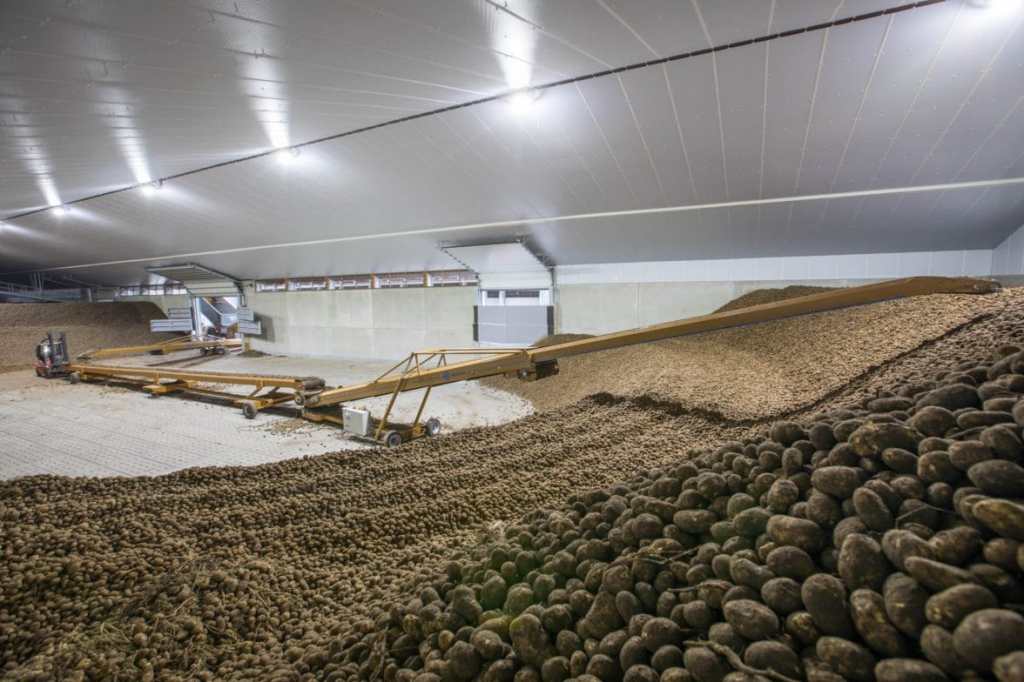
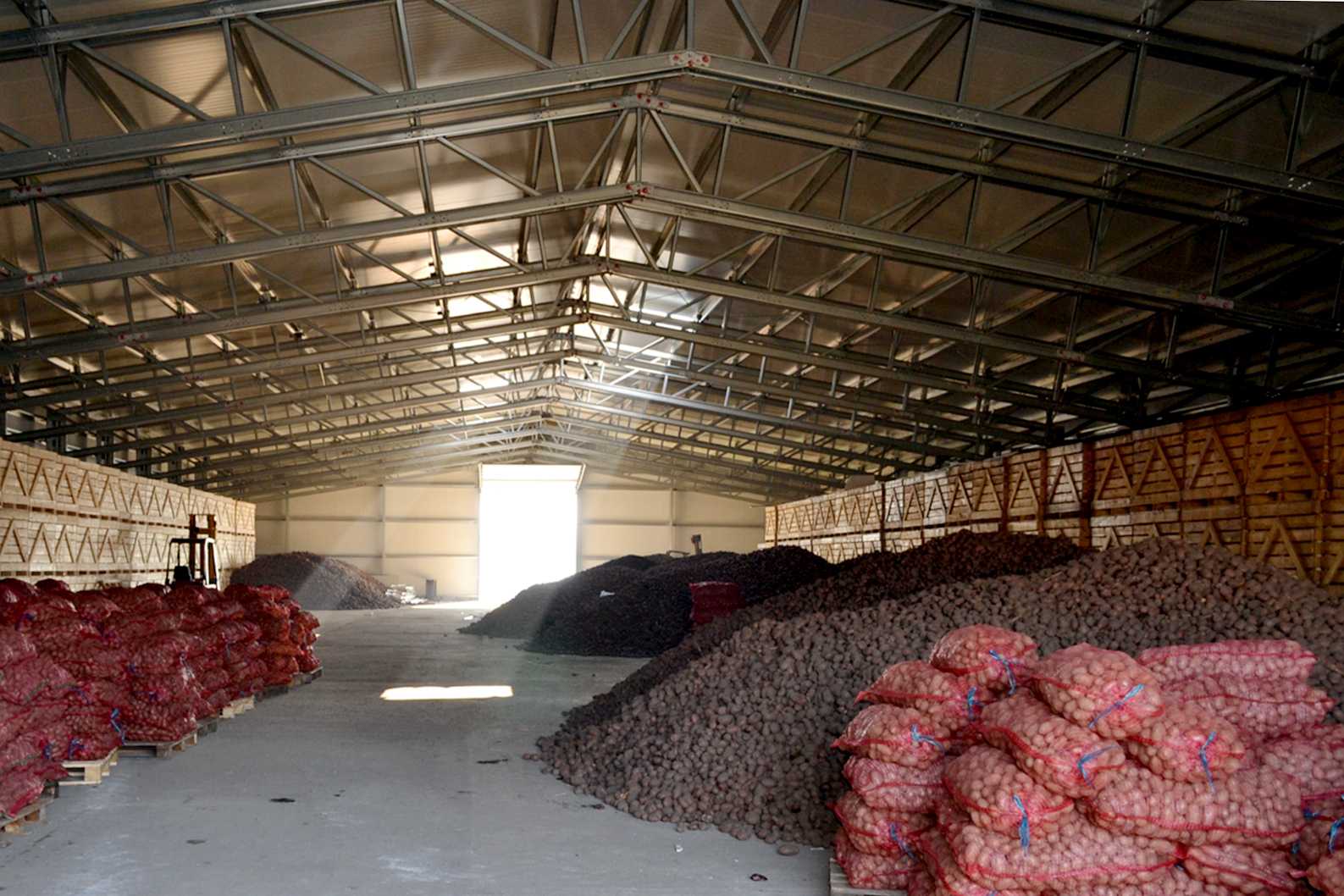
Across the Netherlands, potato farmers are facing one of the most severe market crises in decades. Warehouses are filled to the ceiling, outdoor piles stretch for meters, and yet the market price for free-market potatoes has effectively collapsed. In some cases, farmers are receiving as little as €0.015 per kilogram—a level far below production costs and, in practical terms, close to zero.
For growers like Maarten van der Loo in Moergestel, the situation is unprecedented. After a full growing season, thousands of tonnes of potatoes are sitting unsold or sold at a loss. “You work an entire year and end up financially worse off,” he says, standing in front of a five-meter-high mountain of potatoes. “This has never been this bad.”

A Perfect Storm on the Potato Market
According to market analysts, the current crisis is not the result of a single failure, but of a perfect storm of structural and cyclical factors.
Over the past few years, potato cultivation—especially for frozen fries—has been highly profitable. Strong global demand, particularly from quick-service restaurants and export markets, encouraged growers across Northwest Europe to expand acreage. The 2025 season then delivered excellent growing conditions, resulting in one of the highest potato yields in over 25 years.
The result: supply surged by more than 8% year-on-year in the Netherlands, while demand remained broadly flat. Similar expansions occurred simultaneously in Belgium, northern France and Germany, amplifying the regional oversupply.
“The frozen potato segment was expected to keep growing, but that growth slowed unexpectedly,” explains Cindy van Rijswick, global strategist for vegetables, fruit and ornamental crops at Rabobank. “When supply rises everywhere at once, the market simply cannot absorb it.”
Contracted vs. Free Market Potatoes
An important nuance in this crisis lies in how potatoes are sold. Roughly 80% of Dutch potatoes are grown under contract, primarily for processors producing frozen fries and other potato products. These contracts typically secure volume but not always price flexibility.
The real pain is felt in the free market segment—the surplus volume that processors do not need once contracts are fulfilled. That residual volume is now virtually unsellable.
For growers like Van der Loo, this has led to absurd outcomes. On his last contracted delivery, the combination of ultra-low price and quality deductions meant he actually paid the buyer €1,000 to take the potatoes away.
Below Cost, Deep Below
Production costs for Dutch ware potatoes are estimated at around €0.15 per kilogram, factoring in seed potatoes, land rent, labour, machinery, storage, and energy. Current free-market prices are nearly ten times lower.
From a business perspective, this exposes a structural vulnerability: while downstream actors—logistics providers, processors, retailers—continue to earn margins, the primary producer absorbs the full volatility of supply shocks.
“I find it painful that everyone after me in the chain earns money from my potatoes,” Van der Loo says. “The truck driver, the factory, the supermarket. Yet the price of fries on the shelf hardly moves.”
Why Consumers See No Relief
Despite the collapse in farm-gate prices, retail prices for fries and potato products have barely declined. This disconnect highlights the asymmetry in price transmission within the food chain.
Processing, energy, packaging, labour, marketing, and retail margins dominate the final consumer price. Raw potato costs represent only a small fraction of the shelf price of frozen fries. As a result, even a near-zero farm-gate price barely registers at retail level.
For farmers, however, that marginal fraction is existential.
Surplus Management: Give Away, Destroy, or Repurpose?
As warehouses fill up, growers are scrambling for alternatives. Across the country, potatoes—and other vegetables—are being donated to food banks, distributed for free at local markets, or diverted to animal feed and bioenergy.
While these initiatives reduce food waste, they do not solve the economic problem. Donation still involves harvesting, handling and logistics costs—often paid by the farmer.
Some growers have jokingly suggested turning surplus potatoes into vodka. The irony is sharp: even value-added processing cannot rescue a crop once the market collapses at this scale.

A Structural Lesson for the Sector
From a B2B perspective, the potato crisis exposes several structural issues relevant far beyond the Netherlands:
- Overreliance on optimistic demand projections
- Limited price risk management tools for growers
- Rigid contract structures that secure volume but not income
- Lack of responsive acreage coordination at regional level
Markets will eventually correct themselves. Next season, fewer hectares will be planted, or farmers will switch crops. But for individual growers, that correction comes too late.
“This is agriculture,” Van Rijswick notes. “One year abundance, the next scarcity. The market balances over time—but for individual farmers, the impact can be devastating.”
Looking Ahead
The 2025 potato surplus will likely accelerate discussions about chain transparency, fairer risk distribution, and smarter contracting models. For processors and retailers, the crisis is a reminder that supply security cannot rely solely on grower risk absorption.
For now, Dutch farmers are left staring at full barns, empty margins, and a market that values their product at almost nothing—despite potatoes remaining a staple food and a cornerstone of the European food industry.
The potatoes are there. The value, this year, is not.


 Fresh Food Novelties
Leave a comment