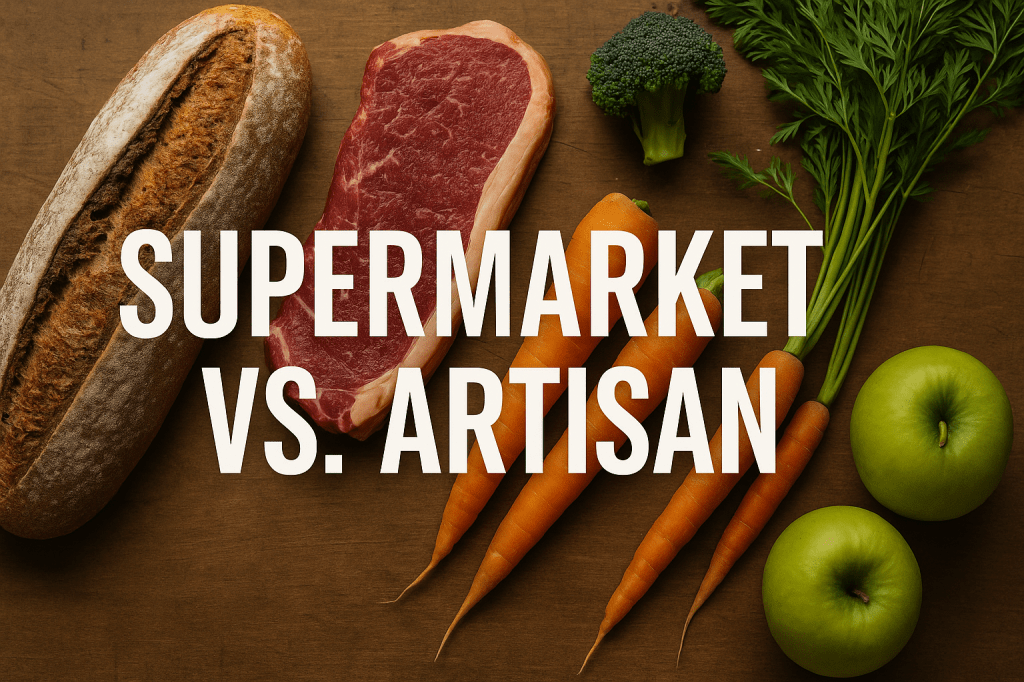
Across Europe and beyond, traditional food specialty stores — such as local bakeries, butcher shops, and greengrocers — are disappearing from the streetscape. At the same time, other specialty outlets like cheese shops, chocolatiers, and delicatessens are holding their ground or even expanding. What explains this divergence?
And more importantly: what should we take from it?
Supermarket Pressure on the Everyday
One key factor is the ever-increasing power of the modern supermarket. Not only do supermarkets offer a broad assortment of bread, pastries, meats, vegetables, and fruits, but the quality of these items has risen significantly in recent years. As a result, the quality gap between supermarket products and artisanal ones is narrowing — or at least, that’s how it appears to the average consumer.
This is especially true for everyday staples. Products such as bread, ground beef, apples, or carrots are purchased frequently, sometimes daily. Supermarkets dominate here, capitalizing on scale, efficiency, and price.
Occasional Goods Escape the Commodity Trap
Contrast this with items like aged cheese, smoked fish, fine charcuterie, or artisanal chocolate. These are occasional indulgences or centerpieces of special meals. Because consumers buy them less often, they are more willing to seek uniqueness — and to pay more. Moreover, the perception of quality differences in these categories is clearer. A raw milk farmhouse cheese or a hand-tempered single-origin chocolate bar speaks its own language of value.
Price Sensitivity and Perceived Value
In high-volume categories, price becomes a dominant factor. Supermarkets leverage purchasing power, automation, and streamlined logistics to win on price. It becomes difficult — and often unwise — for small artisans to compete head-on.
But value is not only about price. It’s about perception. Artisans who succeed do so by making the value visible: through storytelling, quality cues, production transparency, or live interaction with the maker.
When “Everyday” Becomes Invisible
Another challenge is psychological. Bread, meat, and vegetables are often seen as “normal food.” They are consumed habitually, not celebrated. A visit to the butcher is less of an experience than a visit to a fine cheesemonger. The same applies to a traditional bakery versus a specialty chocolate store.
Artisans operating in the everyday categories must therefore work harder to make their offering special again.
Is There Still a Future for the Artisan Butcher or Baker?
Absolutely — but not in the traditional form. The model of a counter, a fixed product range, and passive foot traffic is no longer sustainable. Today’s consumer seeks value, yes — but also experience, meaning, and flexibility.
So what doesn’t work anymore?
- Relying on old customer loyalty
- Offering the same standard range as supermarkets
- Sticking to rigid business hours
And what does work?
- Specialization and differentiation: sourdough, heritage grains, local sourcing, organic certifications, slow fermentation
- Experience and service: personal advice, in-store tastings, hands-on workshops, recipe cards
- Collaboration: teaming up with other local artisans or even supermarkets to create joint offerings or curated experiences
From Competition to Collaboration
This article doesn’t aim to provide all the answers. That’s not its purpose.
Its goal is to raise awareness. To spark dialogue. To suggest that supermarkets and artisans need not be enemies. That future success — for both — may lie in new forms of collaboration. Because while the artisan is under pressure, so too is the supermarket model, facing rising costs, labor shortages, and growing demands for transparency and sustainability.
In a changing food system, commercial thinking requires collective thinking. Not every problem can be solved at the level of an individual entrepreneur. Sometimes, the solution lies in rethinking the ecosystem itself.


 Fresh Food Novelties
Leave a comment