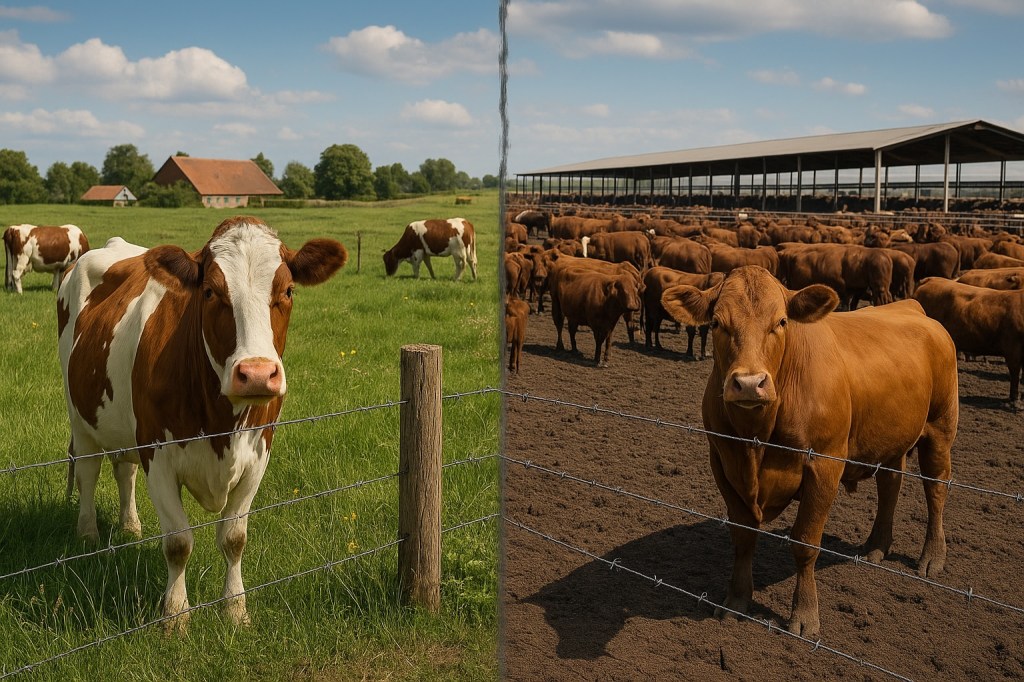
The debate about allowing American beef onto the European market appears, at first glance, to revolve around food safety: hormones, residues, antibiotics. But beneath that surface lies a more fundamental difference. The conflict over beef symbolizes a deeper rift in agricultural philosophy, production scale, and the relationship between farmers and society. In this longread, we explore that divergence, backed by numbers and cultural reasoning.
Two Worlds, Two Systems
The United States and the European Union differ in many ways—economically, legally, historically. But in agriculture, the contrast is structural. It begins with the scale and number of farms.
| Characteristic | United States (US) | European Union (EU-27) | The Netherlands |
|---|---|---|---|
| Population | 340 million | 447 million | 17.9 million |
| Number of farms | ~2 million | ~9 million | ~50,000 |
| Ratio: citizens per farm | 170:1 | 50:1 | 358:1 |
| Cattle (total) | ~91 million | ~76 million | ~3.8 million |
| Cattle per 100 citizens | 27 | 17 | 21 |
| Pigs (total) | ~74 million | ~140 million | ~11.5 million |
| Pigs per 100 citizens | 22 | 31 | 64 |
| Cattle per farm | 45.5 | 8.4 | 76 |
| Pigs per farm | 37 | 15.5 | 230 |
These figures don’t speak for themselves without context. In the US, the agricultural sector is highly concentrated. Farms are typically large-scale, technologically advanced, and owned by agro-industrial conglomerates. The average US farm spans dozens or even hundreds of hectares and often specializes in one crop or animal: beef, corn, soy.
In Europe—and especially in countries like France, Germany and the Netherlands—a different picture emerges. Agriculture is largely family-based, smaller in scale, and often mixed. The farm is not just an economic unit but a social and cultural environment. European farmers often live on their land and see it not only as a production asset but also as heritage and habitat.
Hormones and the Limits of Acceptance
The concrete point of dispute in the beef debate is the use of growth hormones. In the US, it is legal to administer growth-promoting hormones (such as estradiol, trenbolone, progesterone) to cattle, allowing for faster weight gain and reduced costs. In the EU, this has been banned since 1989, based on the precautionary principle and concerns about human health.
This contradiction has fueled decades of trade disputes. The WTO has repeatedly ruled against the EU’s import ban, while Europe holds its ground, citing public concern and its stringent food safety standards.
But it would be a mistake to think the European public worries only about hormones in steak. The underlying fear is that trade may silently import an entire production philosophy. Even a hormone-free steak still reflects a system that is fundamentally different.
Farmers per Citizen
The farmer-to-citizen ratio is a mirror of each region’s farming model. In the US, there is one farm per 170 citizens. In the EU, it’s one per 50. In the Netherlands, a single farm serves 358 citizens. That makes Dutch agriculture extremely efficient—but also vulnerable. The social pressures regarding nitrogen, animal welfare, biodiversity, and climate are concentrated on a very small group with a very large footprint.
Moreover, livestock density in the Netherlands is exceptionally high. The average EU farm holds 8 cattle, while Dutch farms average 76. For pigs, the contrast is even greater: 230 pigs per farm in the Netherlands compared to 15.5 in the EU and 37 in the US.
The numbers make it clear: the Netherlands is an agricultural powerhouse on a postage stamp. Any foreign offer—such as cheap American beef—is not just an economic threat, but a potential disruptor of the delicate social contract between farmers and society.
Free Trade or Value Clash?
Trade deals like TTIP or Mercosur are often framed in terms of economic risk or benefit. But food is not just a commodity; it is an expression of values and norms:
- How much control do we want to retain over our food standards?
- Do we want an agricultural system built on scale, efficiency and consolidation, or do we continue to embrace the European ideal of multifunctional, human-scale farming?
- And how far are we willing to go in sacrificing our own farmers for cheaper imports?
The European resistance to American beef is not irrational. It is a reaction to a slow erosion of a deeply rooted system of agriculture that intertwines with landscape, culture, and community.
Conclusion: More Than a Steak
On paper, American beef is “disqualified” in Europe because of hormone use. But underneath that formal ban lies a broader unease. European agriculture is defending more than market share—it’s defending a way of life, a vision of farming as a socially embedded and ecologically aware practice, not a purely industrial production machine.
When we import beef, we also import a worldview. And it is up to us—citizens, farmers, and policymakers—to decide whether that worldview fits with our vision of sustainable, fair and resilient agriculture.

 Fresh Food Novelties
Leave a comment